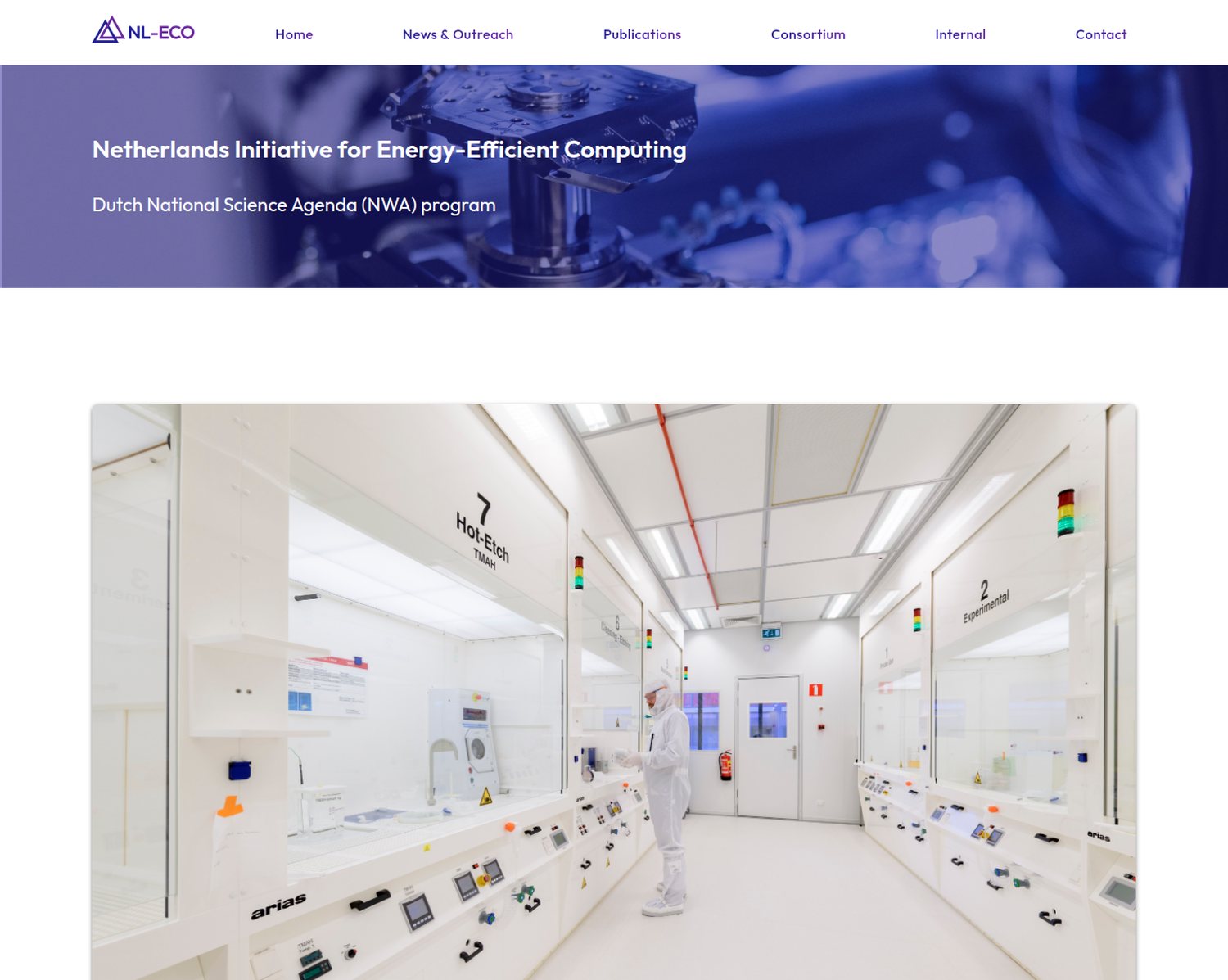
The client
NL-ECO — the Netherlands Initiative for Energy-Efficient Computing — is a Dutch National Science Agenda programme funded by NWO, led by Prof. Hans Hilgenkamp at the University of Twente. It runs on roughly €10M of NWO funding plus €2.5M in consortium co-financing, and brings together 33 academic, industrial and societal organisations including Radboud University, the University of Groningen, TU Delft, SURF, AMOLF and CWI.
Its subject is the energy cost of computing itself: chip technologies combining electrical, optical and magnetic effects, brain-inspired and neuromorphic approaches, and materials structured so that they compute automatically.
What the site has to do
A programme of that shape has several audiences that rarely want the same thing, and the site has to serve all of them without becoming a maze:
- The public and press — a plain-language account of what the programme is and why it matters.
- The research community — publications, tutorials, white papers and roadmap material.
- The consortium itself — an internal area, and a consortium directory covering all 33 partner organisations.
- The programme's own communications — a steady stream of news, events and outreach that has to be publishable by non-technical staff.
The constraint that shapes everything: the people who keep the site alive are researchers and programme managers, not developers. If publishing a news item requires a deployment, the site goes stale within a term.
What we built
Ceilbit delivered the whole thing — I led the company through the engagement, which meant owning the client relationship and the scope alongside the technical work.
Design
A visual identity built around the programme's own branding, clean enough to sit comfortably next to the institutional sites of 33 partner organisations while still reading as its own thing. Structure over decoration: a wide hero, generous whitespace, and content sections that stay legible when a researcher pastes in three paragraphs of dense prose.
Backend and CMS
Behind the public pages is a content management layer with rich-text editing, so programme staff create and edit news items, events, tutorials and publications directly. Each item gets its own stable URL, which matters for a research programme — announcements and tutorials are linked from elsewhere and cited, so they have to keep working.
The consortium directory and publication list are data-driven rather than hand-written pages, so adding a partner or a paper is a content operation rather than a code change.
Deployment
Deployed with automated, reproducible releases, so changes ship predictably and the running site is always a known build rather than whatever was last uploaded. For a client who will outlive any individual contractor relationship, that reproducibility is part of the deliverable.
Why it mattered
Publicly funded research programmes are judged partly on visibility, and the website is where that visibility lands — it is the thing linked in every announcement, every conference slide and every press mention. The interesting work was less in any single technical decision than in building something a research programme can actually run itself for years, across a consortium whose members change over the programme's lifetime.